In this guide
- What Ceramic Coating Actually Is
- What Is Ceramic Coating Made Of?
- How Does Ceramic Coating Work?
- What Does Ceramic Coating Do for Cars?
- What Ceramic Coating Will Not Do
- How Long Does Ceramic Coating Last?
- How Much Does Ceramic Coating Cost?
- How Is Ceramic Coating Applied?
- Which Surfaces Can Be Coated? And Can You Coat Headlights?
- How to Tell If Your Car Already Has a Ceramic Coating
- Looking After a Ceramic-Coated Car
- Ceramic Coating vs PPF: What Is PPF for Cars?
- Is Ceramic Coating Worth It? A Kuwait Perspective
Priced paint protection lately? You've probably hit the term. So what is ceramic coating for cars, really?
A liquid polymer you apply over your car's paint. Once it cures, it hardens into a protective layer that shields paint from road and weather elements for years, according to.
That's the short answer. But this product swims in marketing noise, and Kuwait's heat, sun, and dust make the decision messier than any glossy brochure suggests.
This guide cuts through it. We'll cover what a coating is made of, what it genuinely does, what it won't do, how long it lasts, what it costs, and how it stacks up against paint protection film (PPF).
No hard sell. Just the facts.
What Ceramic Coating Actually Is
Let's start with the definition, because the industry loves to overcomplicate it.
Ceramic coating is a silica-based liquid polymer applied by hand over the vehicle's paint, asexplains.
Apply it. It cures. It hardens into a protective layer that shields paint from road and weather elements. When maintained properly, it stays effective for years.
Driving.ca describes it the same way. A liquid polymer applied to a car's exterior that bonds with the factory paint to form a protection layer.
The core idea is simple: liquid goes on, hardens, bonds to your paint.
That bond is the important part. A coating isn't wax sitting loosely on top. It chemically attaches to the surface. It becomes part of the finish.
The Ceramic Coating Family of Names
You'll see coatings sold under several labels. Don't let that confuse you.
Common names: nano coatings, hydrophobic coatings, silica coatings, glass coatings, quartz coatings, per Xometry.
Marketing uses these interchangeably. They can refer to specific formulations or properties, though.
One distinction matters. Nano coatings use similar active ingredients to ceramics but with much smaller particles. They're measurably less hard, per.
So a "nano" label isn't automatically better. Read what the product actually is. Don't just trust the label.
How It Differs From Wax and Sealant
To place a coating in context, compare it to the two older options.
Wax is organic and cheap. But it's not durable. Apply it several times a year,explains. Environmental contaminants and harsh soap break through that thin barrier easily.
Paint sealants are synthetic and last several months. More durable than wax. They shield paint from mud, detergents, and high temperatures, per.
Ceramic coating sits at the top for durability. It outlasts both wax and paint sealants by a wide margin,notes. That's the main reason owners choose it despite the higher cost.
Think of it as a spectrum: wax for months, sealant for a bit longer, coating for years.
What Is Ceramic Coating Made Of?
This is where the "ceramic" name comes from. Worth understanding.
Ceramic coatings are typically composed of silicon dioxide (SiO₂). Some formulations add titanium dioxide (TiO₂), alumina (Al₂O₃), or zirconia (ZrO₂) for specific properties, according to.
adds that automotive coatings contain silicon dioxide and may include titanium dioxide to extend service life.
Silicon dioxide concentration matters. Professional-grade coatings contain around 80% SiO₂, and come in small containers,reports. That higher concentration is a big reason professional products behave differently from cheap consumer bottles.
One myth to kill: ceramic coatings don't contain PTFE. They're generally considered non-toxic, per. PTFE is the Teflon compound used in non-stick cookware. It's a different thing entirely.
How Does Ceramic Coating Work?
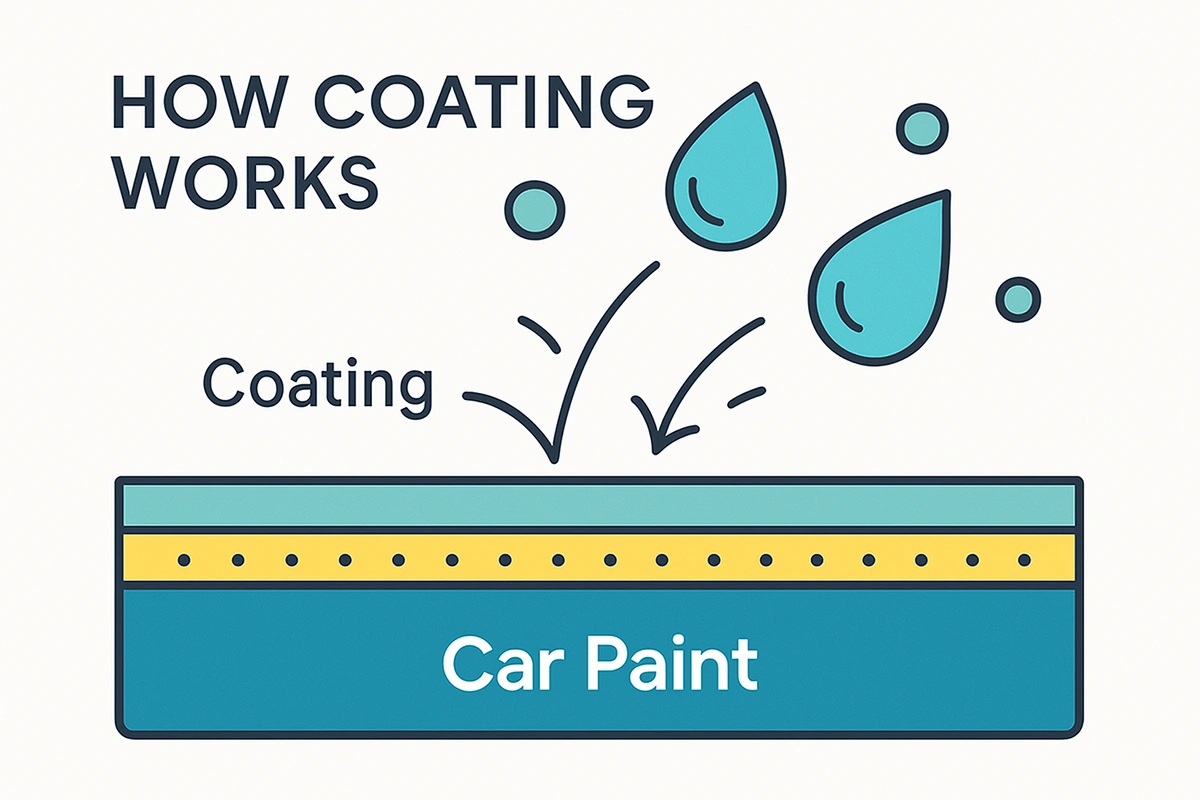
The mechanism is straightforward once you strip away the jargon.
For cars, the coating comes in liquid form with a resin and additives, explains. The resin polymer provides the physical properties. Additives improve how well it sticks.
Apply it to the car. It forms a bond over the painted surface. After it cures, you've got a thin, hard, hydrophobic layer on top of your paint.
That word "hydrophobic" is the one you'll hear most. Water-repelling, basically.
A ceramic coating creates a hydrophobic layer that repels water. Mineral deposits and dirt have less opportunity to damage the paint surface, per.
In practice, water beads up and rolls off instead of clinging and drying on the panel. That's the effect people show off in videos.
What Does Ceramic Coating Do for Cars?
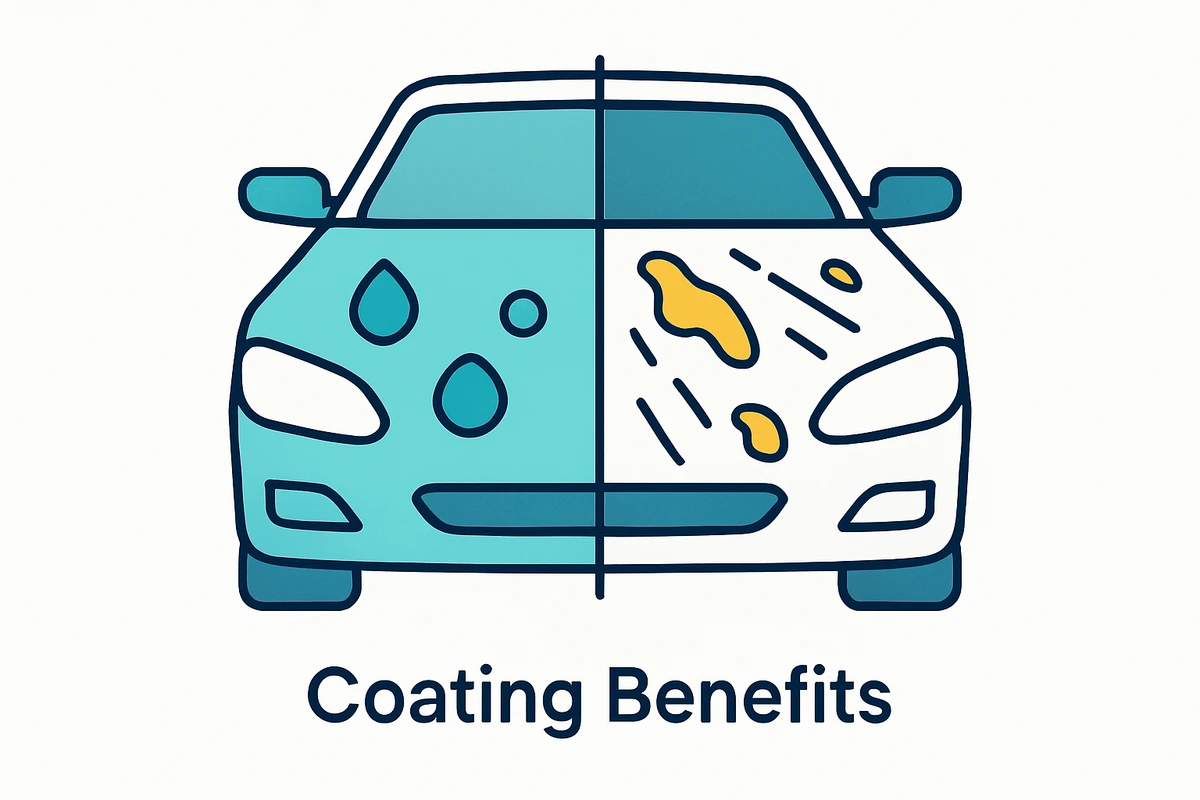
Now the practical question. Beyond the shine in the demo, what does the coating give you?
Here's what the sources actually support.
It repels water and grime. The hydrophobic layer means liquids bead off. Paint stays cleaner between washes, according to.
It resists chemicals, UV, and corrosion. Coatings offer protection against chemicals, rust, corrosion, and UV rays. They enhance gloss and shine,reports.
It guards against everyday contaminants. A coating acts like a hard shell. It stops water stains, road grime, bird droppings, and similar substances from reaching the paint, per. A quick rinse slides most of it off.
It adds surface hardness. Ceramic coatings increase surface hardness, which reduces wear. They improve corrosion and chemical resistance, notes.
It makes washing easier, not rarer. This nuance matters. A coating won't lessen how often your vehicle needs washing. It will make the process much easier,is careful to note.
That last point is one many sellers gloss over. A coating isn't a "never wash again" product. It's a "wash with less effort" product.
The Gloss Factor
There's also the look, which is a real benefit for many owners.
A coating enhances gloss and shine on the paint it covers, according to.
Auto Care HQ lists glossy finish and marring resistance among the core benefits. Also durability and dirt and water repellency.
If your paint is already in good shape, a coating deepens and protects that finish. If your paint is dull or swirled, the prep work before coating is what restores the shine, as we'll cover below.
What Ceramic Coating Will Not Do
This is the section marketing skips, and it's the most important part of an honest answer.
A coating is protection, not armor. Setting expectations correctly saves you money and disappointment.
It will not stop stone chips or dents. Ceramic coatings won't protect against scratches and stone chips,states plainly.
is just as blunt. Stones will still chip your paint. A rogue shopping cart will still dent your fender. A coating is not an impenetrable barrier.
It's not scratch-proof.lists "not scratch-proof" as the first drawback of ceramic coatings.
It can still leave water spots. Here's the counter-intuitive downside.
Water beads and runs off vertical panels but sits on flat surfaces like hoods and roofs. It can leave water spots when the chemicals in that moisture don't evaporate cleanly,explains. Those spots are more likely to form as water evaporates in heat. That water-spot behavior is directly relevant to Kuwait.
So a coating handles chemical and light contamination well. Physical impacts and deep scratches? That's a different problem a coating doesn't solve.
How Long Does Ceramic Coating Last?
This is one of the most searched questions. The honest answer: it depends.
Ceramic coatings last around 3 years on average, but can last anywhere from 1 to 8 years, according to.
Durability depends on the grade of the coating, how it was applied, and how it's cared for. The amount of silicon dioxide in the formula affects the grade directly.
puts a good-quality treatment at up to five years of protection.
frames it more generally: a coating can be effective for several years. It substantially outlasts waxing and paint sealants.
Realistic range: roughly one to eight years. A good professional job commonly lands in the three-to-five-year zone.
Three things move you toward the top of that range: a higher-grade coating, proper surface preparation, and consistent aftercare. Skip any of the three and the lifespan drops.
How Much Does Ceramic Coating Cost?
Price is where many people get sticker shock. Let's separate the product cost from the job cost.
The bottle is cheap. The job is not.
Ceramic coating kits themselves cost less than $100,notes. Consumer bottles range from around $50 to almost $200. The price difference is driven by silicon dioxide concentration, per.
So why do professional jobs cost so much more?
Proper preparation is the expensive part. The coating magnifies any imperfections. The paint must first be polished to remove swirls, scratches, and discoloration,explains.
A professional may charge $1,000 or more to apply a coating, once prep is included, according to.
Interestingly, even brand-new cars usually need this polishing step. Experts note new cars often have slight paint damage from being run through an automatic car wash at the dealer,reports.
So the cheap bottle is real. The labor and prep behind a lasting result? That's what you're really paying for.
How Is Ceramic Coating Applied?
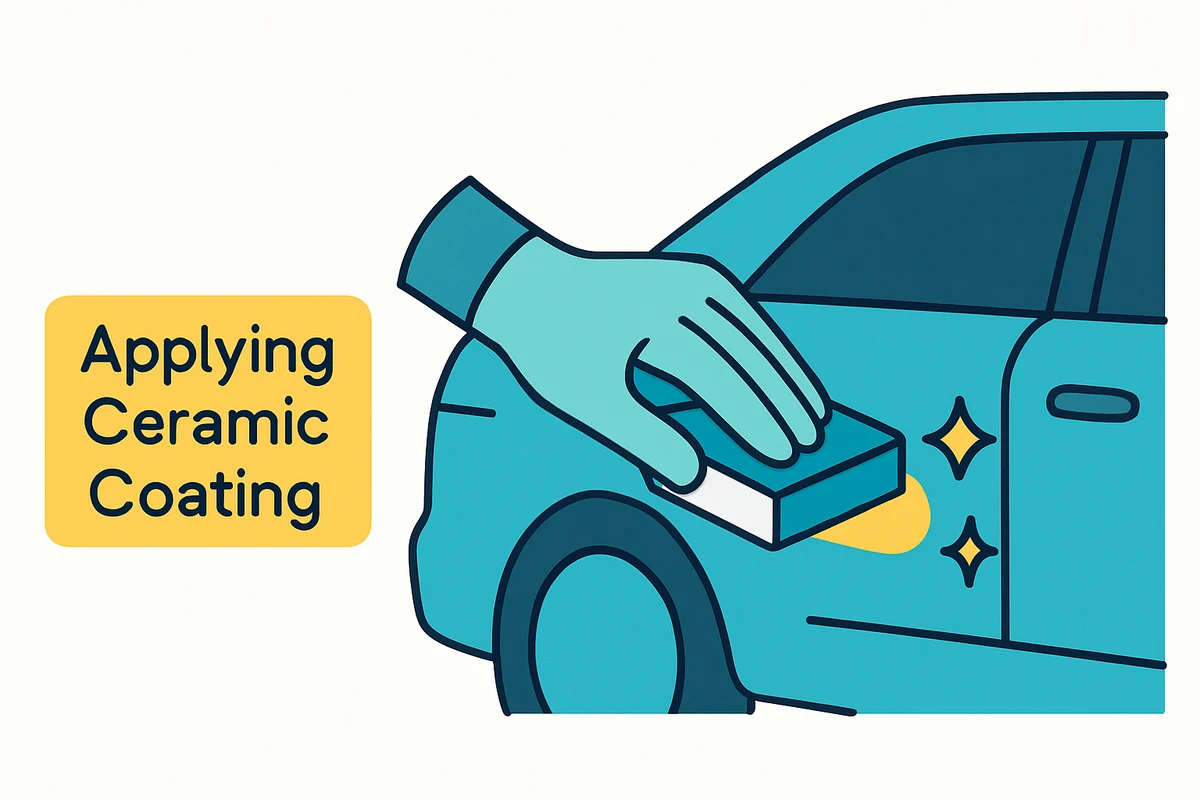
Understanding the process explains both the cost and why doing it badly ruins the result.
The coating itself isn't too tricky to apply. The preparation is time-consuming, labor-intensive, and critical, according to.
The prep stages are roughly:
-
1
Thorough pre-wash and hand-wash
A thorough pre-wash and hand-wash with a dedicated car shampoo removes surface dirt before any decontamination begins.
-
2
Chemical decontamination
Chemical decontamination removes tar and iron fallout deposits that washing alone cannot lift from the paint surface.
-
3
Clay bar decontamination
Physical decontamination with a clay bar lifts remaining contaminants that are bonded to the paint after the chemical stage.
-
4
Machine polishing
Machine polishing removes clear-coat scratches and swirls, correcting the paint so it is free of imperfections before the coating goes on.
-
5
Panel-wipe
A panel-wipe solution strips oils and residues before coating, leaving a clean substrate ready to bond.
-
6
Coating application
Only after all of that does the coating go on. It's applied in small sections in a cross-hatch pattern, then leveled and buffed with fresh microfiber towels to prevent high spots,explains.
Rush or skip the prep, and the coating won't bond well. It can look a mess,warns.
Can You Apply Ceramic Coating Yourself?
You can. But go in with realistic expectations.
DIY application is doable if you have patience, do a thorough wash first, and follow the label instructions, according to.
The catch is the margin for error. A coating bonds to your paint. It can't simply be wiped off and reapplied like wax,explains. It's more like staining wood, where the application must be smooth and consistent.
If something touches the surface before it cures, or a mistake is made, an entire section may need wet-sanding and re-coating, per. For that reason, they don't recommend the average DIY attempt on a car of real value.
There's also a curing window to respect. A coating can take up to 24 hours to fully cure. Until then the surface is sticky and grit will stick to it,notes.
So DIY is realistic for a hobbyist on a lower-value car. On a car you care about, the professional prep is usually where the money is well spent.
Which Surfaces Can Be Coated? And Can You Coat Headlights?
A common question: is coating only for paint?
No.
Ceramic coatings are typically applied to paintwork, but they can also be used on glass, alloys, painted calipers, exhaust, metal trim, black plastic trim, headlights, leather, and interior plastics, according to.
Yes, you can put ceramic coating on headlights. That said, different surfaces generally call for different coating formulations. A glass coating behaves differently from an interior-trim coating,explains.
Practical takeaway: don't assume one bottle is right for every surface. Match the coating to the job.
How to Tell If Your Car Already Has a Ceramic Coating
This one rarely gets a clear answer online. Here's a practical approach.
The most reliable everyday sign is the hydrophobic behavior. A coated surface makes water bead up and roll off rather than sheet and cling. This follows directly from the hydrophobic layer described byand.
Simple check: lightly mist a clean panel with water. If the water forms tight beads that run off quickly, some form of hydrophobic protection is likely present.
Treat this as a strong hint, not proof. A fresh wax or sealant can bead too. Beading fades as any coating ages. If you bought the car used and beading is weak or patchy, it's safest to assume protection has worn thin.
When in doubt, a detailer can assess the paint properly and tell you what, if anything, is on it.
Looking After a Ceramic-Coated Car
A coating changes how you should wash your car. Get this wrong and you shorten its life.
Wash regularly, but the right way. A coated car should ideally be washed every couple of weeks if it's high-mileage and stored outside. No less often than monthly, according to.
Avoid harsh automated washes. Never take a coated car through an automatic car wash or a cheap roadside hand-washing station,warns. That can damage the coating.
Respect the initial cure. After a fresh application, avoid washing the car for the first week to let it cure. Keep it covered if it rains,advises.
Wash with a pH-neutral car shampoo. Favor brush-free methods to avoid swirls. Dry with water-absorbing microfiber towels to prevent water spots, per. In Kuwait's heat, washing a coated car in the midday sun is a recipe for spotting — wash in shade or early morning instead.
Can You Pressure Wash a Coated Car?
Yes, with one condition.
A ceramic-coated car can be pressure washed without damaging the coating, as long as the coating has fully cured, according to. Curing may take up to two weeks.
Don't aim a pressure washer at a coating you applied yesterday. Once it has cured, it holds up fine.
Can You Wax Over a Ceramic Coating?
Also yes.
Waxing over a ceramic coating is acceptable and can enhance the finish,notes. One thing you should not do: polish the coating. Traditional polishing can deteriorate it.
That's the key rule: wax over it if you like, but never polish a cured coating.
Ceramic Coating vs PPF: What Is PPF for Cars?
If you've researched ceramic coating, you've almost certainly hit the abbreviation PPF. They're often compared, and confused. Let's define PPF clearly.
What is PPF? Paint Protection Film (PPF) is a clear, durable urethane film applied to a vehicle's surfaces to protect the paint from scratches, chips, and other damage, according to the RAC. It's designed to absorb impact and defend against road debris, UV rays, and environmental contaminants.
PPF has an interesting origin. The US military asked 3M during the Vietnam War for a solution to protect helicopter rotor blades from flying shrapnel and debris, as Wikipedia records. Some in the industry still call it "helicopter tape".
Today's automotive PPF is highly conformable and optically clear. Many products are multi-layered with a self-healing top coat that reforms after being scuffed or scratched,explains. That self-healing can maintain clarity for more than ten years.
Theconfirms the self-healing behavior: minor scratches can disappear with heat or sunlight. PPF typically doesn't need replacing for five to ten years.
The Core Difference
Here's the distinction that actually matters when choosing.
PPF is designed for physical protection against light road debris and scratching. That's different from liquid coatings and sealants designed mainly for UV and chemical resistance,explains.
In plain terms:
Ceramic Coating
- Thin liquid layer that excels at chemical resistance and UV protection
- Enhances gloss and makes cleaning easier
- Doesn't stop chips, per
PPF
- Thicker physical film that absorbs impacts and resists chips and scratches
- Can self-heal minor marks with heat or sunlight
- Designed for physical protection, per the
They're not really rivals. They solve different problems. Many owners use both: PPF on high-impact areas and a coating over the rest.
Notably, some PPF products now also offer hydrophobic properties similar to a ceramic coating,adds. The line between them is blurring at the premium end.
PPF Costs and Downsides
PPF is the more expensive of the two.
Prices for PPF can start from around £1,000 and, for higher-spec vehicles or full coverage, can exceed £5,000, according to the.
Its drawbacks include that price, the need for correct installation (poor application can bubble or peel), the need for specific cleaning products, and the fact that deeper scratches will still break through the film, theexplains. If you keep the car for many years, the film will eventually need replacing.
PPF can be applied to the whole vehicle or just to high-impact areas such as the bonnet, wing mirrors, bumpers, and door frames, thenotes. That partial approach is a good way to manage cost while protecting the panels that take the most abuse.
Is Ceramic Coating Worth It? A Kuwait Perspective
Now the question everyone actually wants answered. Is a coating worth it, especially here?
The honest answer depends on your car, your budget, and your expectations. But Kuwait's conditions do shift the math. Here's how to think about it.
The sun and UV argument favors a coating. Kuwait's intense, near-constant sunlight is hard on paint. Coatings offer real protection against UV rays while enhancing gloss, asnotes. That UV defense is genuinely useful in a high-sun climate. Treat this as sensible advice for our conditions, not a guaranteed outcome.
Dust and sand are the caveat. Our fine, abrasive dust is constant. A coating is not scratch-proof, per. Wiping dusty paint with a dry cloth can still put swirl marks in it. For chip and abrasion resistance on the front of the car, PPF is the tool designed for physical protection, asdescribes.
Heat makes water spots a real risk. This is the local point worth flagging. Water can sit on flat panels and leave spots as it evaporates in heat, per. Washing a coated car in the midday sun is a recipe for spotting. A practical habit: wash in shade or early morning and dry with microfiber. That aligns with theadvice to dry with absorbent towels to prevent water spots.
The value case is about maintenance and looks, not invincibility. A coating makes washing easier and keeps paint cleaner between washes, per. It protects against chemical contamination like bird droppings and road grime, per. If those benefits match what you want, and you accept it won't stop stones or dents, it's worth it.
If your main worry is physical damage from gravel and debris, put your money toward PPF on the impact zones instead. If your main worry is UV, chemical stains, gloss, and easy cleaning, a ceramic coating fits. Many Kuwait owners sensibly combine both.
Frequently asked questions
Does a coating mean I never have to wash my car?
No. It makes washing easier, but the car still needs regular washing, per.
How long will it last?
Around three years on average, ranging from one to eight depending on quality, application, and care, according to.
Is it toxic?
Ceramic coatings are generally non-toxic and don't contain PTFE, per.
Can I pressure wash it?
Yes, once it has fully cured, which can take up to two weeks, per.
Can I coat my headlights?
Yes, headlights are among the surfaces coatings can be applied to, per.
Is PPF or ceramic coating better?
They do different jobs. PPF is for physical impact protection, while ceramic coating is for UV, chemical resistance, and gloss, perand.
The bottom line
A ceramic coating is a silica-based liquid polymer that bonds to your paint and shields it from UV, chemicals, and grime while making the car easier to clean and adding gloss, asanddescribe. It's not scratch-proof and won't stop stone chips, perand. For that, PPF is the film designed to absorb physical impact, per the. The result you get depends almost entirely on preparation and aftercare — rushed prep or harsh washing undoes even the best product.
That preparation is exactly where experience pays off. If you want your paint properly decontaminated, corrected, and protected the right way for Kuwait's sun and dust, the Paint & Detailing team at Posefore Wash & Polish can help you choose and apply the protection that actually fits your car and how you drive.