In this guide
- Why Washing Your Car the Right Way Actually Matters
- What You Need to Wash a Car at Home
- What Soap to Use to Wash a Car
- Timing and Setup: Where and When to Wash
- The Two-Bucket Car Wash Method Explained
- How to Hand Wash a Car: Step by Step
- How to Dry a Car Without Swirl Marks
- Washing With a Pressure Washer or Foam Cannon
- How to Wash a Car Without a Hose
- How to Wash a Car With a Ceramic Coating
- How to Go Through an Automatic Car Wash
- Finishing Touches: Wax, Tires, and Protection
- How Often Should You Wash Your Car?
- Washing Your Car in Kuwait's Heat, Dust, and Hard Water
- Answers to Common Car-Washing Questions
- The Bottom Line: A Wash That Protects, Not Just Cleans
Learning to wash a car properly is the best habit you can develop for keeping your paint glossy and protected. It sounds simple. But the way most people do it quietly adds scratches every single time.
The two main culprits are improper washing and incorrect drying, according to Adam's Polishes. The good news? Avoiding damage doesn't take much. Just the right order, the right products, and a little care.
This guide walks you through the whole process. From choosing soap to the two-bucket method, drying, ceramic coatings, automatic washes, and the extra demands of a hot, dusty climate like Kuwait.
Why Washing Your Car the Right Way Actually Matters
A clean car isn't just about looks. Frequent washing is the best way to maintain a new-car finish and to spot problems early—rust or loosening trim, Consumer Reports notes.
There's a financial angle too. Keeping dirt and grime off your car is routine maintenance that helps retain value, Kelley Blue Book explains.
Washing also delivers real benefits: better resale and a longer life for the vehicle, Motor Authority points out.
So a wash is maintenance, inspection, and value protection rolled into one. That's why the method matters as much as how often you do it.
What You Need to Wash a Car at Home
Gathering everything first saves time and gives better results. It stops you from scrambling for a mitt while a harsh wheel cleaner or hard water sits on a surface,.
Your car wash kit
- Two buckets, ideally with grit guards or dirt traps at the bottom
- A dedicated, vehicle-specific car wash soap
- A soft wash mitt, wash pad, or large natural sponge
- A separate sponge or brush just for the wheels and tires
- A hose with an adjustable nozzle
- Clean microfiber drying towels or a chamois
- A wheel cleaner and, if needed, a bug-and-tar remover
You don't need to spend a fortune. Two five-gallon buckets and a grit guard cost a few dollars at a home improvement store rather than from a premium detailing site,.
The separate wheel sponge is important. Wheels and tires carry sand, brake dust, and debris that could mar the paint, so keep that sponge separate from the one you use on the body,.
What Soap to Use to Wash a Car
This is where most home washes go wrong. The soap you choose has a direct effect on your paint's protection.
Use a dedicated car-wash product. It's milder and specifically designed for automotive paint,.
A vehicle-specific, pH-neutral soap matters because household soaps dry out rubber seals and trim, and they strip wax and sealants from paint, which then lets water spots form easily,.
Dedicated car soaps also contain lubricants that help lift dirt from the surface so it rinses away safely, reducing the risk of scratching,.
When shopping, remember: "pH-neutral" and "for automotive use." That single choice prevents a lot of long-term damage.
Can You Wash a Car With Dish Soap?
Yes, but only occasionally, and with a clear understanding of the trade-off.
Nonabrasive dish soaps are safe to use infrequently for washing a car, and Procter & Gamble even recommends its Dawn dishwashing soap to remove grease and grime from exterior car surfaces,.
The catch is what dish soap removes along with the grime. Repeated use degrades the clear coat, creating a dull look, and it strips off any previously applied wax or paint sealant, leaving the paint unprotected,.
Here's the chemistry: dish soap is usually alkaline with a higher pH to break down grease, while car wash soap is typically pH-neutral. Consistent use of higher-pH soaps promotes oxidation of the paint and dries out the trim,.
Consumer Reports is firmer on this. It advises against household cleaning agents like hand soap, dishwashing detergent, or glass cleaner on paint, because they're not formulated for it and may strip the protective wax,.
The practical takeaway: reach for dish soap only to strip old wax before re-protecting the car, or as a one-off in a pinch. Don't make it your weekly routine.
Homemade and Alternative Car Wash Soap Options
If you're out of car shampoo, gentler options than dish soap exist.
Baby soap and pet shampoo are good substitutes. Both are gentler than liquid dish soap and won't remove wax or paint protection,. A workable ratio is one ounce of baby or pet shampoo per gallon of water,.
One warning if you improvise: don't confuse liquid dish soap with powdered dish detergent. A car wash uses cold water and undissolved detergent grains could scratch the paint,.
Whatever you mix, always pair it with the two-bucket method described below, so any grit stays away from your paint,.
Timing and Setup: Where and When to Wash
Before you touch the car, get the conditions right. This step prevents more damage than any product can fix.
Don't wash your car when the body is hot—right after driving or after it's sat in direct sun. Heat speeds the drying of soap and water, making washing harder and increasing the chance that spots and deposits form,.
Work in the shade. Direct sunlight makes suds dry up far too fast, Chemical Guys notes. Motor Authority agrees, adding that you should work quickly and efficiently so neither water nor soap dries on the paint,.
Prep the whole work area first. Get the chemicals, towels, buckets, and hose ready so water never dries on the vehicle. Hard water especially risks etching the paint,.
The Two-Bucket Car Wash Method Explained
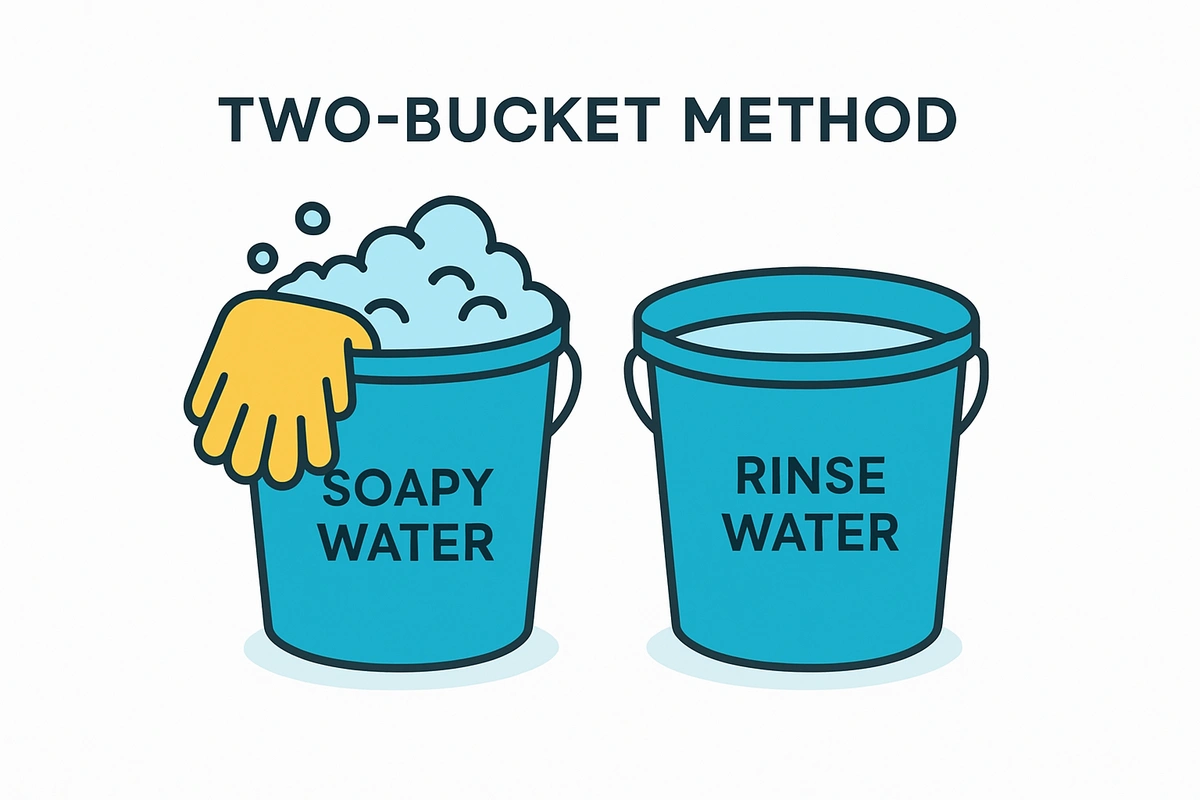
If you take one technique from this guide, make it this one. It's the core of a safe hand wash.
Washing causes unnoticed scratches and swirls because dirt gets into the wash bucket and gets applied to the car over and over. The two-bucket method prevents that dirt from re-entering the wash bucket, Cartec explains.
Here's how it works:
- Fill one bucket with clean water and the other with clean water plus car shampoo,.
- Put a grit guard or dirt trap in the bottom of each bucket so debris settles and stays there,.
- Dip the mitt in the shampoo bucket and wash one panel, working top to bottom,.
- Rinse the mitt in the clean-water bucket regularly to remove the dirt, then reload it with suds,.
- Repeat panel by panel until the whole car is washed, then rinse the car until all shampoo is gone,.
One bucket holds your soapy solution and mitt. The second is only for rinsing the mitt. This way you clean the car instead of spreading grime around it,. A separate rinse bucket keeps dirt from mixing back into the sudsy wash water,.
How to Hand Wash a Car: Step by Step
Now put it together. This sequence keeps the dirtiest grit away from your paint for as long as possible.
-
1
Clean the Wheels and Tires First
Start with the wheels because they're usually the dirtiest part of the car,. Doing them first also means you don't end up with hard water sitting on freshly cleaned body panels,.
Make sure the wheels are cool to the touch, and clean only one wheel at a time so the cleaner doesn't sit too long and stain or damage the finish,.
Choose your wheel cleaner carefully. Be sure it's compatible with the wheel finish, because a strong formula meant for mag wheels can damage the clearcoat on modern wheels. Look for one labeled safe for all wheels,.
Spray the cleaner, scrub with a dedicated wheel brush, and rinse each wheel thoroughly before moving on,. Then, if you used the same buckets, dump and refill them with fresh water before washing the body,.
-
2
Pre-Rinse the Whole Car
Rinse all surfaces thoroughly before you begin washing to remove loose dirt and debris that could otherwise cause scratching,.
Don't just hit the easy spots. Give extra attention to the wheel wells and lower panels, where grime collects. Rinse from the top down so dirt travels downward,.
-
3
Deal With Stubborn Residue
Some contamination won't budge with soap alone. Grease, rubber, and road-tar deposits gather around the wheel wells and lower body and may need a bug-and-tar remover applied with a soft, nonabrasive cloth,.
For stubborn bug splatter or tree sap, apply the remover, let it sit, then rinse and wash that area as normal,.
Be gentle with bug guts and bird droppings. Don't scrub with heavy force, because those particles can scratch or scuff the surface,.
-
4
Wash the Body, Top to Bottom
Load your mitt with sudsy water and wash using a side-to-side motion. Never use circular motions. Start at the roof, then the glass, then the hood, and work your way down,.
Straight lines matter. Moving the sponge in circles creates light but noticeable scratches called swirl marks. Move lengthwise across the panels instead,.
Wash from top to bottom because a car is dirtiest along its lower third, where road grime is kicked up,.
After each panel, rinse the mitt in the grit-guard bucket, wring it out, and reload it with suds before the next panel,. Work the solution into a thick lather that lubricates the paint, and rinse the mitt often,.
One useful habit from Adam's: leave the pH-neutral soap on the panel rather than rinsing between panels. A quality car shampoo rinses cleanly at the end and this helps prevent water spots forming mid-wash,.
If your mitt or sponge drops on the ground, don't keep using it without rinsing it thoroughly. It will pick up dirt particles that scratch the paint,.
-
5
Rinse the Car Thoroughly
Once the whole car and wheels are washed, rinse from the top down and make sure all the soap is gone,.
Pay attention to the hidden traps. Door handles, grilles, mirrors, and cooling vents all hold soap residue. Rinse those areas well,.
A tip for a polished finish: rinse with an open hose with no nozzle, letting water sheet over the car from top to bottom. This lifts soap while reducing pooling and makes drying easier,.
How to Dry a Car Without Swirl Marks
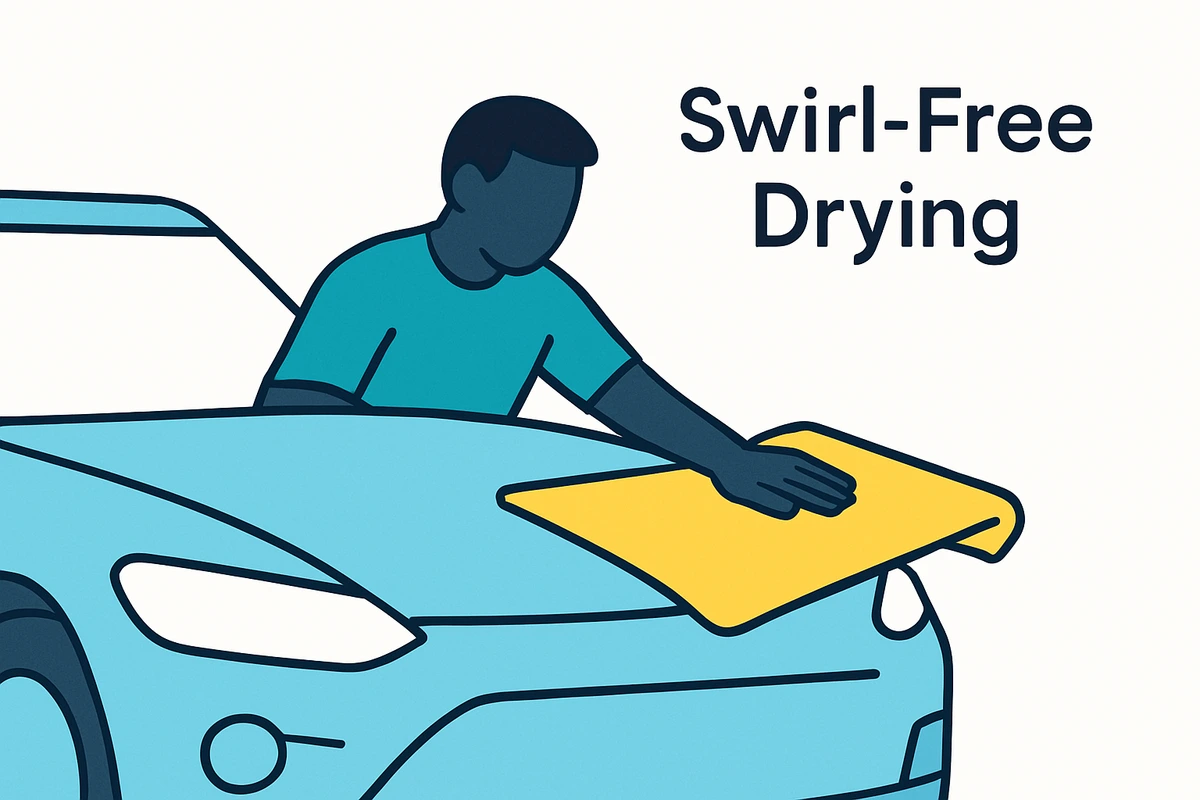
Drying is where a good wash gets ruined most often. Air drying is a mistake.
Don't let the car air dry. It leaves watermarks caused by minerals in hard water. Don't use an abrasive towel either—it leaves hairline scratches,.
Use a chamois or soft microfiber towels, and blot the water up rather than dragging the towel across the paint,. Dry with long, sweeping motions that follow the curves of the car,. A drying aid or quick detailer spray, misted on before you dry, helps reduce water spots and adds lubrication,.
To speed things up and avoid touching the paint at all, you can blow the water off. Motor Authority uses a leaf blower to remove most of the water,. Consumer Reports suggests the same trick with a light-duty, battery-powered blower to avoid electrical issues near water,.
Don't forget the hidden water. Badging, door sills, gaskets, grilles, and mirrors trap water that later drips out and leaves etched spots. Blow those crevices out,.
Washing With a Pressure Washer or Foam Cannon
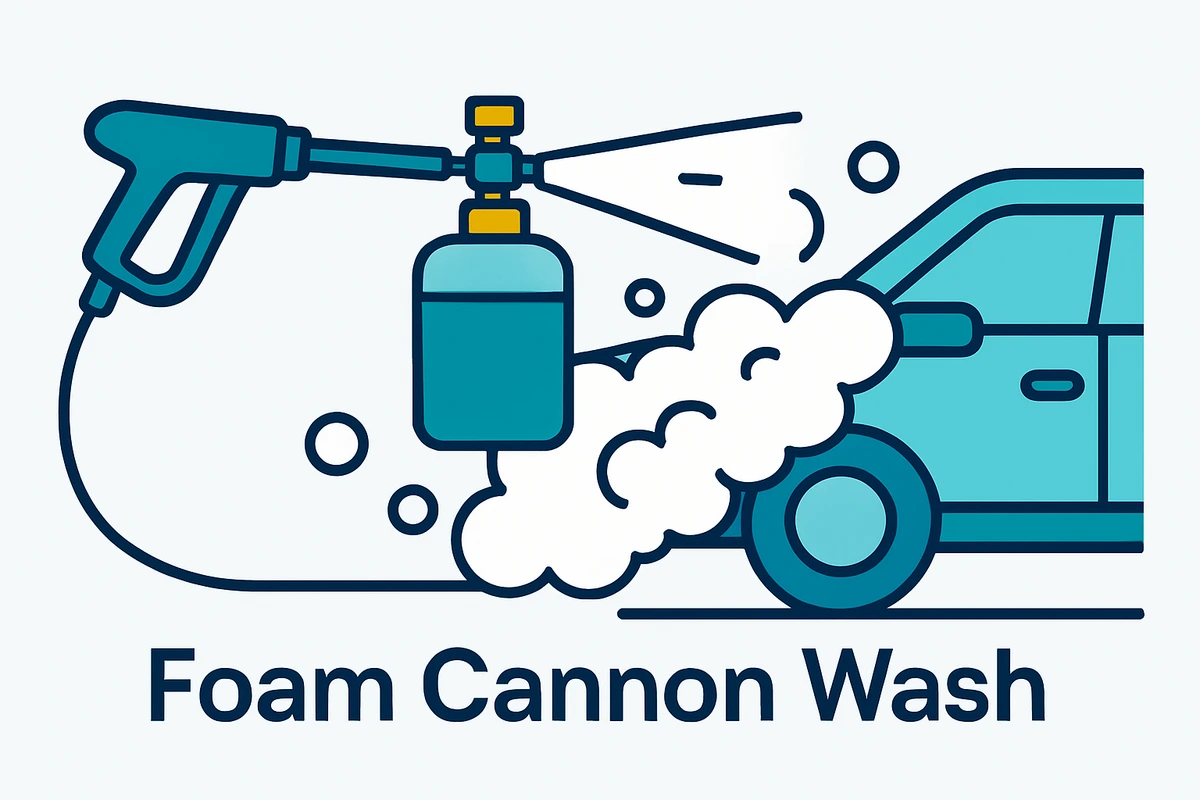
A pressure washer makes the rinse faster and the pre-wash more thorough, but technique matters.
Don't use a zero-degree tip. It can damage paint. A 40-degree nozzle gives a wide, safer spray,.
A foam cannon or foam gun lets you coat the whole car in suds first. This wets the dirt and loosens it from the surface before you ever touch the paint,.
Even with a foam pre-soak, you still follow up with the two-bucket contact wash. The foam loosens grime; the mitt and grit guards carry it safely away.
How to Wash a Car Without a Hose
No hose or running water doesn't mean you have to skip the wash entirely.
Hand frothers can be used with a hoseless wash solution to safely clean the exterior in a pinch,. For a lightly dusty car, you can use the hoseless solution as the wash itself and then wipe it off with a clean microfiber towel,.
Slick spray detailers also work as a lubricant with microfiber towels when there's no running water available,.
This waterless approach is genuinely useful in apartment living and in water-restricted areas. It's best kept for light dust, not for a car caked in mud or road grime.
How to Wash a Car With a Ceramic Coating
A ceramic coating changes what your paint needs, but not the fundamentals of a safe wash.
The same rules still apply: use a gentle, pH-neutral car soap. Stick to the two-bucket method. Avoid harsh, high-pH household products that strip protection. Since a ceramic coating is your protective layer, the alkaline, wax-stripping soaps flagged above are exactly what you want to keep away from it,.
Skip anything abrasive. Wash top to bottom with straight-line motions and dry by blotting with clean microfiber. That's the swirl-avoiding technique,, so you don't scour the coating.
In short, a coated car is easier to clean, not exempt from care. Gentle products and gentle contact keep the coating doing its job.
How to Go Through an Automatic Car Wash
Sometimes you just want a quick, hands-off clean. Automatic washes are convenient, but they come with trade-offs and a few steps many drivers get wrong.
Are Automatic Car Washes Safe for Your Paint?
Automated washes freshen the car and spray winter salt off the undercarriage, but motorized brushes can damage paint by grinding in grime from other cars or by catching loose parts like trim or rear wipers,.
If you do use one, touchless washes are best for protecting your car. The trade-off is that they may not get the finish quite as clean,.
A coin-operated pay-and-spray bay is a good middle ground. Just take care not to blast off fragile trim or bump the paint with the metal nozzle,.
Do You Put the Car in Neutral in a Car Wash?
For a conveyor-tunnel wash, the standard instruction is to select neutral and switch off the engine, WashTec explains.
But newer cars complicate this. Many now have an automatic parking brake that activates as soon as the engine is switched off. This can lock the tires and make the car jump out of the conveyor system,.
If a P symbol lights up in the cockpit when you switch off the engine, that parking brake has engaged. In that case, turn the ignition back on and leave it on the whole way through so the brake doesn't block the conveyor chain,. Alternatively, deactivate the vehicle's "Auto Hold" function before you drive in, then switch it back on afterward,.
Getting In and Out Safely
Most conveyor-wash damage happens at two points: driving in and driving out,.
On exit, a small jolt usually signals that the belt has released your rear wheels, often with a green light, sound, or announcement. After that you can select drive and pull away,. If the exit signal appears but your wheels are still on the belt, tap the brake very gently, then engage drive and go. Braking hard on the conveyor isn't allowed and can cause damage,.
A few more systems are worth switching off. An automatic start-stop system activates when you brake, so disable it before entering,. Deactivate the rain sensor too—the wipers may run and get damaged. Turn off parking sensors so they don't beep continuously at the brushes,.
Finish with the classics: remove the aerial, fold in the side mirrors, and protect a rear wiper if the wash provides a cover,.
Finishing Touches: Wax, Tires, and Protection
A wash is the foundation. A couple of finishing steps make it last.
Treat the car to a seasonal waxing to help protect it from the elements and restore a like-new shine,.
For deeper protection between washes, wipe the paint down with a clean microfiber towel and a spray detailer or wax,.
On tires, hold off on dressings if longevity is your goal. Tire makers told Consumer Reports that aftermarket dressings aren't needed to preserve tires and that the shine is merely cosmetic. Tires already contain antioxidants and waxes that migrate to the surface to protect the rubber,. Simple soap and water is all the tires need,.
For bonded contamination that washing leaves behind, a clay bar with a detail-spray lubricant pulls it off the paint,. That's an intermediate step, not part of every wash.
How Often Should You Wash Your Car?
Frequency depends on where and how you drive. As a rule of thumb, a bi-weekly to monthly wash keeps a car clean and protected,.
That's a baseline for mild climates. In harsher conditions, you'll want to wash more often.
Washing Your Car in Kuwait's Heat, Dust, and Hard Water
Kuwait's environment is tough on paint, and it magnifies every rule in this guide. Treat the following as practical local guidance built on the same principles the sources describe.
Heat is the biggest factor. Because you should never wash a hot body panel or work in direct sun,, a Kuwaiti summer leaves a narrow window. Wash in early morning or after sunset, in full shade, and work fast so soap never flashes dry.
Fine dust is constant here. That makes the pre-rinse and the two-bucket method non-negotiable. Dragging airborne grit across paint is exactly how swirl marks form. Rinse generously first, then let the grit guards do their work.
Hard water is the other local enemy. Since minerals in hard water leave watermarks if the car air dries,, dry immediately and completely. Blow out every crevice so nothing drips and etches later in the sun. A drying aid helps here.
Frequency also climbs in this climate. Between dust storms and salty coastal air, the monthly baseline is often not enough. Inspect and rinse more regularly than a temperate-climate schedule would suggest.
Answers to Common Car-Washing Questions
A few practical questions come up again and again.
Can you wash car mats?
Rubber and all-weather mats clean easily with soap, water, and a brush, then air dry fully before they go back in. Carpeted mats can be shampooed and left to dry completely so they don't trap moisture and odor.
Treat a washing machine as a last resort and only for mats explicitly labeled machine-safe. Rubber backing and machine agitation don't always mix well.
How do you keep microfiber towels clean?
Keeping them clean matters because, as the sources stress, any grit on a towel or mitt scratches paint,.
How do you wash a car cover?
Follow the cover's own care label. Many can be gently hand-washed or machine-washed on a delicate setting with mild soap, then air-dried. Always defer to the manufacturer's instructions rather than a generic method.
How do you wash the undercarriage?
An automated wash is an easy way to spray grime and salt off the undercarriage,. At home, a pressure washer with a wide-angle tip aimed up under the car does the job.
The Bottom Line: A Wash That Protects, Not Just Cleans
The bottom line
Washing a car well is really about order and gentleness. Clean the wheels first. Pre-rinse. Use a pH-neutral soap and the two-bucket method. Wash top to bottom in straight lines. Dry without dragging. Do that and you clean the car while protecting the finish, instead of quietly scratching it. That's exactly the outcomeanddescribe.
If the heat, dust, and hard water make a proper at-home wash hard to fit in, a professional touch helps. The Mobile Car Wash service from Posefore Wash & Polish brings this careful, paint-safe process to your location across Kuwait.
Your car gets the two-bucket treatment without you standing in the sun. Whenever you're ready for a hands-off clean done the right way, it's there to help.